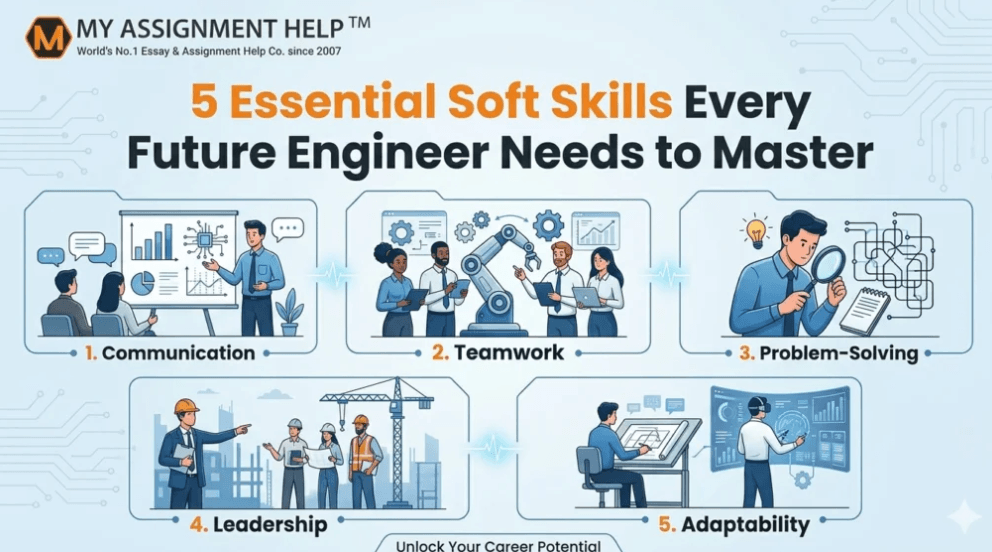
The traditional image of an engineer—huddled over a drafting table or a workstation, lost in complex calculations and CAD software—is undergoing a radical transformation. In the modern American workforce, technical prowess (hard skills) is merely the baseline for entry. According to a recent survey by the National Association of Colleges and Employers (NACE), employers rank “Communication Skills” and “Teamwork” significantly higher than technical fluency alone when hiring recent STEM graduates.
As the industry shifts toward cross-functional teams and agile environments, the ability to translate “technical-speak” into “business-value” has become the hallmark of a senior-level professional. For students currently navigating the rigors of a Bachelor of Science in Engineering, balancing these interpersonal nuances with heavy lab schedules can be overwhelming. Many students find that utilizing specialized engineering assignment help allows them to manage their technical workload more effectively, freeing up bandwidth to participate in leadership roles and extracurricular projects that build these vital soft skills.
The pressure to maintain a high GPA while developing a well-rounded professional persona is immense. When the burden of complex projects becomes a bottleneck to personal growth, some students choose to do my homework through expert academic consultants to ensure they don’t fall behind in the competitive US job market. Mastering the following five soft skills will ensure that you don’t just get hired, but that you lead.
1. Technical Communication: Bridging the Gap
Engineers rarely work in a vacuum. You will eventually have to explain why a specific bridge design requires a higher grade of steel to a city council or why a software architecture needs a complete overhaul to a marketing executive.
- The Data: A study by Project Management Institute (PMI) found that 1 out of 5 projects fail due to poor communication.
- Application: Practice “The ELI5 Method” (Explain Like I’m Five). If you can explain the Second Law of Thermodynamics to a non-engineer without using jargon, you possess a skill that is worth a premium in the corporate world.
2. Collaborative Leadership and Teamwork
The days of the “lone genius” are over. Projects like the James Webb Space Telescope or Tesla’s Gigafactories are the result of thousands of minds working in sync.
- The Data: According to LinkedIn’s 2024 Global Talent Trends, 92% of talent professionals say soft skills matter as much or more than hard skills, with “collaboration” being the most requested skill in engineering job descriptions.
- Application: Seek out multidisciplinary teams. Work with business students, designers, and marketers. Understanding their “language” will make you a more effective leader.
3. Ethical Judgment and Integrity
As an engineer, your decisions have real-world consequences, from data privacy to structural safety. The “Move Fast and Break Things” mantra is being replaced by a more cautious, ethical approach to innovation.
- The Data: The National Society of Professional Engineers (NSPE) emphasizes that the public’s health and safety must be the engineer’s “paramount” concern.
- Application: Study the Boeing 737 MAX case study or the Flint water crisis. Understanding where others failed ethically is crucial to your development.
4. Adaptability and Continuous Learning
The half-life of a technical skill is now estimated to be about five years. What you learn as a freshman may be obsolete by the time you are a junior engineer.
- The Data: The World Economic Forum predicts that 50% of all employees will need reskilling by 2030 due to the adoption of AI and automation.
- Application: Develop a “growth mindset.” Don’t just learn a tool (like Python or Revit); learn the underlying logic so you can pivot when the next tool arrives.
5. Critical Thinking and Problem-Solving
While engineering is built on formulas, the most difficult problems don’t have a back-of-the-book answer. Critical thinking involves questioning the “why” before the “how.”
- The Data: The American Society for Engineering Education (ASEE) highlights that “Complex Problem Solving” is the top skill needed for the Fourth Industrial Revolution.
- Application: Don’t just follow the lab manual. When an experiment fails, treat the failure as a data point.
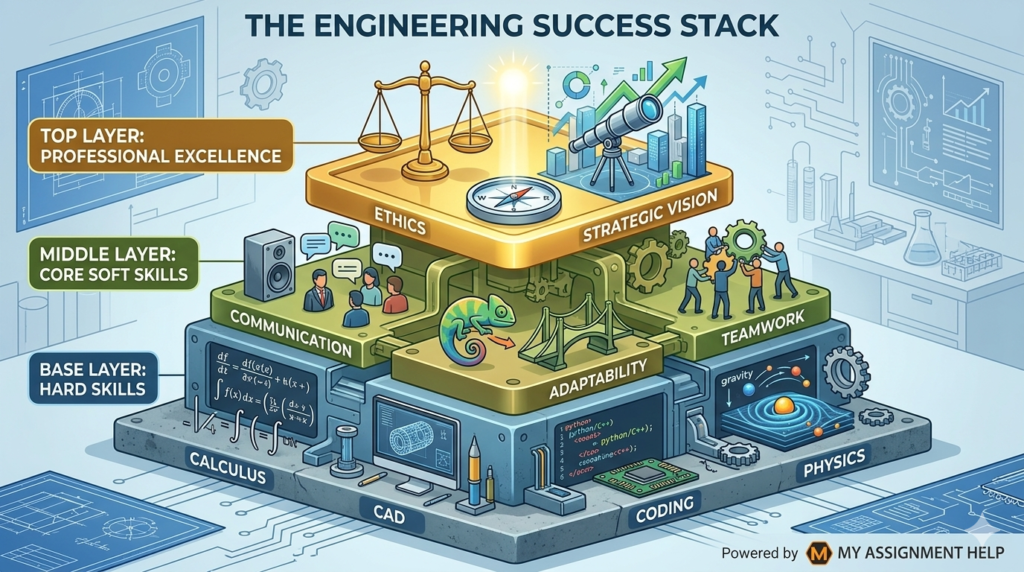
Key Takeaways
- Communication is King: The ability to explain technical concepts to non-technical stakeholders is the fastest way to a promotion.
- Data Supports Soft Skills: Major organizations like NACE and LinkedIn confirm that teamwork and communication are top priorities for recruiters.
- Balance is Essential: Use academic support resources to manage your workload so you can focus on holistic development.
- Ethics Over Ego: Technical brilliance cannot replace the need for ethical responsibility in public safety.
See also: Tokenization of Real-World Assets Explained
FAQ Section
Q1: Can soft skills really be learned, or are they innate?
A1: Soft skills are like muscles; they require exercise. Through public speaking, group projects, and active listening, any engineer can improve their interpersonal effectiveness.
Q2: Why do US employers value soft skills so highly for entry-level roles?
A2: Most US firms expect to train you on their specific software or hardware systems. What they cannot easily teach is how to be a dependable team player or a clear communicator.
Q3: How can I showcase soft skills on a technical resume?
A3: Use “Action Verbs.” Instead of saying “worked on a team,” say “Collaborated with a 5-person multidisciplinary team to deliver a solar-powered prototype 10% under budget.”
References
- National Association of Colleges and Employers (NACE). (2024). Job Outlook Survey.
- Project Management Institute (PMI). (2023). Pulse of the Profession Report.
- LinkedIn Talent Solutions. (2024). Global Talent Trends: The Rise of Soft Skills.
- World Economic Forum. (2023). The Future of Jobs Report.
Author Profile
Dr. Sarah JenkinsSenior Academic Consultant at MyAssignmentHelp Dr. Jenkins holds a Ph.D. in Mechanical Engineering from Georgia Tech and has over 15 years of experience in both industrial design and academic mentoring. She currently leads the content strategy at MyAssignmentHelp, focusing on bridging the gap between rigorous academic theory and practical industry requirements for students across the United States. When she isn’t auditing engineering curricula, she advocates for STEM mental health and time-management strategies for undergraduate students.